August 05, 2015

Fotiy Krylov (Фотий Крылов) docks in Corinto, with a friend?

Marshal Gelovani
Photo Credit: Savitskiy Igor / ShipSpotting.com
Taken November 24, 2014 in Vladivostok
Following up on my last post about this interesting tug, the Fotiy Krylov (IMO 8613346 / MMSI 273441150) showed up at 2015-08-05 00:38Z at the Port of Corinto, Nicaragua.

The Port of Corinto is classified as a small port in the Northern Pacific, and has considerable warehousing and rail links to move cargo to/from the port.

So what?

Well, the Fotiy Krylov doesn't usually travel alone, but as a tug she usually has her AIS beacon on, unlike spy-ships or other ships of war.  So, who's she travelling with this time?

Rumour has it she's with the Project 862/II Marshal Gelovani (NATO: Yug Class) Hydrographic survey vessel. I can't find an IMO or MMSI for her, just a reference to 906O.  I also found reference that she is an AGE: General Purpose Experimental Ship (AGE = Auxiliary General Experimental).  I wonder if she's experimenting with something, and what they're up to?

The only thing I know that's going on in Nicaragua is the new canal which is being bankrolled by the Chinese, which is going to erode the American-controlled Panama canal's monopoly.  Just today they announced potential changes to the Pacific entry of the canal.  Are the Russians helping with oceanographic surveying?  Are they experimenting with new sonar?  Nicaragua is an ally of Russia, so any number of other projects could be going on, or they could have just stopped for some fuel and cigars.  I really don't know.

Title: Marshal Gelovani
Russian Navy Auxiliary
Project 862/II  |  NATO: Yug Class
Launched: 11.02.1983
Commissioned: 29.07.1983
Serving: Pacific Fleet / Vladivostok, Russia
Concept / Program (multiple sources have the ship listed differently):
  AGE: General Purpose Experimental Ship (AGE = Auxiliary General Experimental)
  General-purpose research ship
  Ekspeditsionnoye Okeanograficheskoye Sudno (EOS); Expeditionary Oceanographc Vessel
  Hydrographic survey vessel
Displacement: 1,892 tons / 2,490 tons (full)
Dimensions: 82.5 x 13.5 x 3.97 meters/270.6 x 44.3 x 13 feet
Propulsion: 2 Sulzer diesels, 2 shafts, 3,600 bhp, 15.6 knots
Crew: 46 civilian + 20 mission crew + 4 passengers/transients
Built: Poland, Stocznia Polnocna, Gdansk
  [information compiled from multiple sources]

Fotiy Krylov's last recorded position:


Corinto, Nicaragua:

August 02, 2015

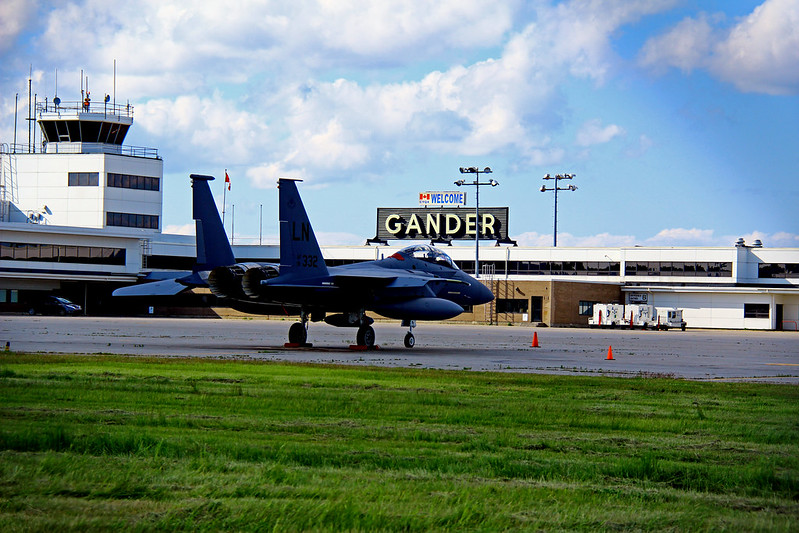
USAF F-15E Strike Eagles hanging out in Gander, Newfoundland?

Gander Airport - F-15
Credit: "No Name D" / Flickr - July 13th, 2015

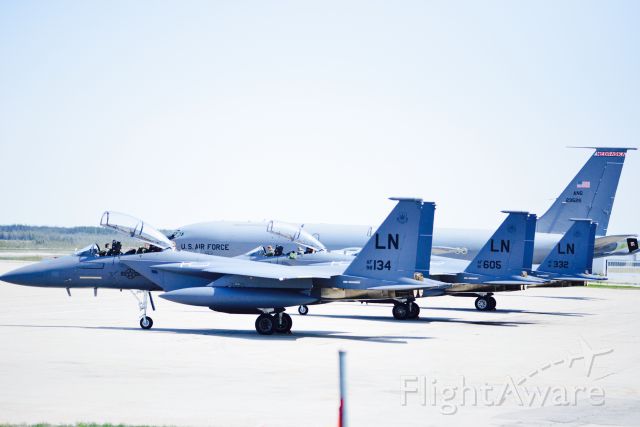
I'm not sure what the story is here, so I'm putting it out on the Internet to see if someone can fill in the blanks.  It seems on June 4th 2015 three USAF McDonnell Douglas F-15E Strike Eagles from RAF Lakenheath landed at Gander International Airport (CYQX) with a Boeing KC-135 Stratotanker.

Why is this interesting?

Several reasons.

At the time there was a rumour of an in-flight emergency, but I can't find any details.
There is also a rumour they were on their way to Iraq and/or the Azores (on their way to Iraq I guess?), but they're still there, as of last week.

The tail numbers of the planes are 98-0134, 91-0605 and 91-0332.
FlightAware Photo
Photo Courtesy of FlightAware.com - Rick Stead

Each of these planes are usually at RAF Lakenheath in the UK, as shown by the LN on their tail. (ref http://www.au.af.mil/au/awc/awcgate/af/tail_markings.pdf )

However, the tail also usually has a red or blue stripe along the top indicating their squadron, and the squadron number was painted on the tail as early as last year (ref: http://www.f-15e.info/joomla/operators/134-tailcodes#0-7-ln ) What does the lack of squadron number mean?  Are these being decommissioned, or redistributed to another base?
Either way, why keep the LN while in transit..?

Could this be related to the USAF re-org from the beginning of January 2015? (ref: http://theaviationist.com/2015/01/09/uk-base-selected-to-host-first-u-s-f-35-jets-in-europe/ )

More pictures here:
http://flightaware.com/photos/airport/CYQX/sort/date
http://jetphotos.net/showphotos.php?location=Gander%20Int%27l%20Airport%20-%20CYQX

...and HD video!


...and big thank you to Marcus and Todd for sending me photos when they were in Gander recently :)

August 01, 2015

A Marathon MIL-Spec Stopwatch from the Cold War

I know I'm stretching the Cold War linkage with what I consider a cool stopwatch from eBay, but I do enjoy looking for a good deal on neat military gear.  Once and a while I find something awesome on eBay, but sometimes I get euchred.  I haven't figured out which way this deal has gone, yet.

The back of the case is stamped:

STOPWATCH
MIL S 14823
6645 00 126 0286
GALLET CO
DLA 400 90 C 5008
891707256
U.S.

Meaning:

It's a stopwatch (that seemed obvious)
It conforms to a revision of the military standard for stopwatches
It has a National Stock Number (NSN)
Manufacturer name
Government contract this was made under
Serial number

  • Because MIL-S-14823 came before MIL-S-14823A, I going to make the leap that the watch was designed to the specification that was the standard for stopwatches between 1968 and 1988.  It is possible that this watch was made in 1989, before watches conforming to the new standard were being built.  From posts online from military pilots issued similar stopwatches in the mid 1980s, they mention a fibreglass backing.  This stopwatch has a metal case, brass perhaps.  I'm not sure if this indicates an earlier or later model, but the specification doesn't mention anything about a fiberglass vs metal back.
  • The National Stock Number is an excellent source of information, but I haven't been able to figure out when Marathon / Gallet was issuing these stopwatches.  Tag Heuer also sold watches conforming to that spec with the same NSN to the US Military (presumably under a different contract).
  • Gallet & Co. is one of the oldest Swiss watch manufacturers in the world, and well known to make an excellent timepiece.  I'm unclear of their relationship with Marathon Watch Co., but Marathon may be a subsidiary or related in some other way as they seem to source some of their watches or parts from Gallet.
  • DLA400-90-C-5008 is the government contract number this was produced under, which was awarded to Marathon Watch Company, Ltd of Canada, but I'm not sure when the contract was issued or completed. (I tried finding reference to the original contract on American government web sites, but none went back that far)
  • The serial number may have additional information encoded in it (is it actually from 1989?  89XXXXXXX) but I dont know enough about their watches to be able to say.

Below is the PDF version of the superseding military specification, which is probably pretty close to the one this stopwatch was made to conform to.

July 28, 2015

Building A Strategic Air Force, Moody, 1995 - Reference Documentation

If you've been following along, you'll have noticed I'm embedding more reference material.  That's not an accident, and may be skirting copyright laws, but the idea is to provide you with already freely available documents that you would otherwise need to track down.  While I could provide you with a link to a copy of that document "somewhere" on the internet where I found it originally; sites get redesigned and links get broken, which is why I'm hosting them on Google Docs and embedding them with the available Google embed code.

Here you have:
Building A Strategic Air Force, Walton S Moody, Air Force History and Museums Program, 1995

Of particular note I thought General Curtis E. LeMay's interest in developing Goose AB into a strike base equipped with B-47 bombers which would be able to strike the Soviet Union was extremely interesting. General LeMay was the commander of the SAC from 1948 to 1957 - right in the middle of the expansion into Goose Bay, Morocco, and Spain.

Page 271
LeMay’s staff studied possible solutions to the problem of basing. The
northeastern region of North America was crucial, for a long-range air
striking force based there could reach most of the potential targets. Some
medium-range aircraft would have to land at bases overseas, and a few
sorties launched from Alaska would complete the coverage. The principal
northeast bases then available included Goose Bay, Labrador, and Ernest
Harmon Air Base in western Newfoundland. Both had significant draw-
backs. Goose Bay was ice-bound for half the year and inaccessible by land.
Newfoundland (including Labrador) became a Canadian province in 1949,
raising the prospect of political complications. Eventually, the planners’
choice fell on Limestone, Maine, which SAC had considered a future B-36
base since the start of construction in 1947. LeMay envisioned an installa-
tion large enough to handle sixty B-36s permanently assigned and more
staging through from the interior. Ultimately other fields might be added
in that area. Also, weather permitting, Goose Bay might serve as a
launching field for tankers and medium bombers deployed from the
States.

Page 272
Farther to the northeast, improvements at Goose Bay had come
under consideration. Currently, the base belonged to the Military Air
Transport Service. The war plan called for staging SAC bombers through
Goose Bay on deployment. The installation was thus crucial in the existing
plan as well as for the future. Early in 1948, a team of Army and Air Force
officers visited the area and concluded that Goose Bay could serve as a
staging field for B-36s. On taking command, LeMay argued more strongly
for Limestone, but still saw uses for the Labrador base. He objected to
proposals to use Pepperel Air Base in eastern Newfoundland. It was
nearer the superior port facilities at St. John's and Torbay, to be sure, but
the SAC Commander discounted its value as an airfield and noted that
Goose Bay afforded better coverage of the targets.


July 19, 2015

Canadian Forces / US Military / NATO Scepter Military Fuel Cans (MFC)


I know full well that my 1999 6.5L TurboDiesel GMC Suburban K2500 doesn't need to be the "ultimate" bug-out vehicle, I'm not expecting to survive the Zombie Apocalypse, but I did want to be able to transport as much Diesel as I could fit behind the 3rd row of seats - sealed, and not leaking in case I wanted to travel far into the bush, or bring enough fuel for myself and a 2nd vehicle.  I wanted to use military surplus jerry cans as well, because they're strong and built to military specifications.
So how much Diesel can fit behind the 3rd row? It seems the magic number is twelve 20L Military Fuel Cans (240L).

Scepter has been manufacturing Military Fuel Cans (Jerry Cans) for the Canadian Forces (and US Military, and NATO) for at least two decades, and skids of surplus cans show up at Crown Asset Disposal from time to time.  I have not been fortunate enough to find such a skid, but by keeping an eye on Kijiji, and having some luck, I have come into possession of twelve such cans.  All have come with their fair share of scratches and marks, but I like that, it gives them character! The problem is, some of them leak from around the opening - but why?

This video described exactly why:


So now I'm posed with the issue of fixing them... but where do I get parts?  eBay?  Well, yes I could, but no seller has all the parts I need in one place.  From the video above I know I need gaskets, replacement yellow tabs for some, and flanges.

So I check Scepter's web site

There's Princess Auto; and who doesn't love Princess Auto?!  Me right now, because they don't have the parts I need, they just occasionally have military fuel canisters for sale.

There's Rampart International, who sell a lot of Scepter stuff - but not the small parts.  So, they're off the list despite being Ottawa-local.

...then there's DS Tactical in British Colombia who's got everything, online, and ready to order!
YOU DS Tactical get my business because you're better than the rest of the Scepter dealers in Canada.
Thank you for making business easier!

The order has been placed, and hopefully I'll get the parts by the end of the week.

Update: Within an hour of the parts arriving, all MFC cans were repaired (although in hindsight I could have used one more flange and another seal...).   The net cost of all of them is still a fraction of MSRP, even with the pricey parts from DS Tactical.  Worth it, IMHO.