I'm going a little off topic, but for historical grounds that will become clear.
 |
| Credit: Steffan Watkins 2009 |
What was the first Cold War site I went to that got me all excited to find *Canadian* Cold War sites?
 |
| Credit: GlobalSecurity.org |
I was in the lovely Albuquerque, New Mexico, on business, and in my spare time was researching what was done back in the day of the Manhattan Project at the Sandia National Labs site, as well as the adjoining Kirtland Air Force Base. As it turns out, the area was a hotbed of atomic weapons history, which might explain why they have a museum (which I didn't visit...). Along with a boat-load of test sites, there was a munitions storage facility for nuclear weapons - THE biggest in fact, back in the day. It was called Site Able - later renamed The Manzano Base, until it was swallowed up by the Kirtland AFB.
 |
| The Manzano Base - Plant 1 |
I've quoted a bunch of documentation below for your reading pleasure, but to sum up, they built a new nuclear storage bunker to the west (buried underground) and moved all the nukes out ~1994. The inside of the mountain was drilled/blasted/dug into in two places, and maze-like weapons facilities, where they would maintain and perform upkeep on the old plutonium dependant nukes (Plant 1 and 2). By 1962 the nuclear weapons being used no longer needed the same maintenance, and the facilities were no longer suitable for the maintenance that was needed; so two new buildings outside the mountain were built and used (Plant 3 and 4). The underground bases were... "re-purposed". Happily I've found diagrams of the cavernous depths of the two plants in the mountain.
 |
| The Manzano Base - Plant 2 |
As I said, after 1994, there were no more nukes being stored, and the nuke upkeep wasn't being performed there any more... so the base was without purpose, right?
Well, I'm familiar with what a disused base looks like, and most wouldn't have a full parking lot, or have new satellite dishes being installed, so... I'm going to go out on a limb and say there is a new lodger down that rabbit hole on the west side of he mountain called "Plant 1", and that the southwest warehouse area has a lot going on too. Are they connected or being used by the same groups? I don't know.
The mountain has dozens of bunkers carved out of the side of the mountain, but to the best of my knowledge only 5 are being used today for (nuclear?) waste storage. I've marked them on the map.
 |
| Credit: GlobalSecurity.org |
An interesting link between Sandia National Labs and Canada exists - they developed (or at least performed testing on) the Genie AIR-2 missiles, which were stored in Special Ammunition Storage facilities at various Canadian bases, outfitted for use on Canadian RCAF planes during the Cold War. They were at least partially disassembled and processed at Sandia when they were returned to the United States at the end of the service life.
The following web site is full of factual inaccuracies, as you'll see from the US Military's official account below, which makes a lot more sense.
http://www.globalsecurity.org/wmd/facility/manzano.htm
<...>
Portions of America's nuclear stockpile was stored in Manzano (the Spanish word for apple) Mountain for 40 years, and nuclear weapons are now secured in a modern underground complex at Kirtland Air Force Base. A presidential emergency relocation center was built deep inside Manzano Mountain as a command post for President Eisenhower. It retained this function until the advent of thermonuclear weapons, by which time it was no longer regarded as a survivable site.
<...>
The Manzano Weapons Storage Area [Manzano WSA] at KAFB consists of 4 plants inside Manzano Mountain (used primarily for research activities)
<...>
In June 1992, the Manzano WSA was deactivated, including deactivation of the Perimeter Intrusion Detection and Alarm System, and Phillips Laboratory assumed responsibility for its maintenance. SNL continues to provide minimum security, although the Perimeter Intrusion Detection and Alarm System was deactivated with the termination of the main mission in 1992. Some of the old tunnels and vaults in the Manzanos still serve as storage. The Manzano WSA is currently being used in part for storage of a variety of items such as furniture and document boxes.
<...>
Here is another 3rd party account of the site, and notes that the warheads were moved to the new storage facility (The Kirtland Underground Munitions Storage Complex) ~1994
http://cryptome.org/eyeball/kumsc-bird/kumsc-birdseye.htm
<...>
The 56-acre KUMSC was completed in 1994, consolidating warhead storage in a new facility outside of Manzano mountain. (Kirtland Underground Munitions Storage Complex) is located on the southeast side of the installation, approximately 3.5 miles east of the main base. Nuclear weapons moved by air in and out of KUMSC use the Albuquerque International Airport.
<...>
Here is a 1st hand account of a veteran who worked at the base; and no, the new nuclear storage facility's location isn't classified.
http://www.processreality.com/my-atomic-days5.html (2009)
<...>
What used to be Manzano AFB is now simply the Air Force Nuclear Weapons Center. It was a storage site for nuclear weapons. It was surrounded by four fences. There was a compound area next to all the tunneling. I once ate at the Manzano compound cafeteria.
This mountain is still a highly classified area, so determined web searches might return next to no information. Over the years, a newer, more hardened, repository has been built somewhere on Kirtland ABF; however, all those details are highly classified.
<...>
Here is where the information starts getting far more interesting, as we're pulling the information from official government documents
National Register of Historic Places Historic Context and Evaluation
for Kirtland Air Force Base (June 2003)
http://www.denix.osd.mil/cr/upload/kirtland-historic-context_0.pdf
Page 103
<...>
The two plants for inspection, maintenance, and weapons modification were tunneled into the Manzano Mountains. These were in effect a maze of vaulted tunnels connecting working bays, emergency generators, and facilities for personnel. Plant 1 was completed in 1949 and Plant 2 in 1950 (Verhaaren 1998). The various chambers of the plants were built underground, both to minimize the effects of an accidental explosion and to protect their contents.
<...>
Page 129
<...>
By the late 1950s, most weapons no longer required intensive maintenance because of advances resulting from Sandia Laboratory’s wooden bomb concept. The new generation of weapons was better stored in larger, aboveground plants. At this time, portions of the underground plants began to be used for other activities.
<...>
Page 165
<...>
After 1962, Manzano Base’s underground facilities began to be used for other purposes, including testing and storage for Sandia Laboratory. Because weapons were being designed
increasingly maintenance-free, the elaborate underground facilities constructed for maintenance and modification of nuclear weapons had become obsolete (Verhaaren 1998).
<...>
Page 166
<...>
Also during 1971, weapons maintenance activities from the four plants at the Manzano area were consolidated into just two plants, Plants 3 and 4, which remained in use until after the end of the Cold War (1991 and 1992, respectively). After the consolidation, part of Plant 1 was used by the security police as a communications center from 1971 through October 1992. Sandia Laboratories, as it had been renamed in 1969, continued to use the underground plants for testing and storage. And Manzano area continued to function as storage and maintenance areas, but for an increasingly diverse array of weapons and other materials (Verhaaren, 1998).
<...>
and more interesting still...
AIR FORCE AMMUNITION AND EXPLOSIVES STORAGE & UNACCOMPANIED PERSONNEL HOUSING DURING THE COLD WAR (1946-1989)
SITE REPORT: KIRTLAND AIR FORCE BASE, ALBUQUERQUE, NEW MEXICO
(AUGUST 2008)
http://www.denix.osd.mil/cr/upload/Kirtland-AFB-Public.pdf
Page 18
Manzano Base continued in use for the storage of nuclear weapons until 1992 when the Kirtland Underground Storage Complex became operational.
<...>
Some of the facilities continue in use for various purposes (Bilderback and Binder 1999:39)
<...>
Page 19
<...>
At Manzano Base, an underground complex was excavated from the solid granite of the mountain (Plate 3).
<...>
Referred to as Plant 1, all facilities needed for maintenance of the weapons, inert storage, administrative areas, break and
Page 20
change rooms, emergency generators, and support facilities were located deep within the mountain side. The work areas and interconnecting tunnels were of reinforced concrete with vertical side walls and arched roofs; very similar in appearance to an earth-covered igloo magazine (Plate 4). Storage of capsules took place in facilities referred to as “A Structures” (Plate 5). At Manzano Base, the A structures are an integral component of the underground complex that included all the facilities needed in the maintenance of nuclear weapons.
<...>
Page 24
<...>
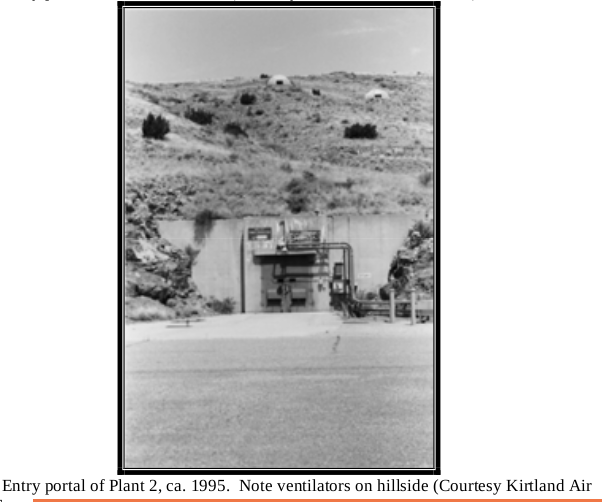
As the stockpile of atomic weapons grew, an additional underground maintenance and inspection plant was constructed at Manzano on the opposite side of the mountain from Plant 1 (Plate 29). Plant 2 was virtually identical in layout and configuration as Plant 1, containing the A and C structures needed for maintenance of the capsules and all the necessary support facilities (Plates 30 through 32)
<...>
Page 25
<...>
Plant 3 (Plate 45). Completed in 1955, this building served the same purposes as Plants 1 and 2 for the disassembly and maintenance of newly stockpiled thermonuclear weapons. These reinforced concrete structures typically contained three bays, with two bays with large sliding doors; the other bay held offices and support areas (Plate 46). Unlike earlier plants where each facet of the maintenance work was carried out in separately reinforced areas, the maintenance bays of the newer plants are not divided and the
building was flat-roofed with vertical side walls (Plates 47 and 48). The two maintenance bays each had a large overhead crane rated at ten tons; inadequate to hoist the entire weight of the early bombs (Plates 49 and 50). A small room adjacent to the central bay held vacuum equipment that connected to a tall stack on the exterior of the building (Plate 51). This was used for venting tritium gas from the primary booster if needed.
<...>
Page 26
<...>
Plant 4 at Manzano, completed in 1953 closely resembles S Structures at other installations that handled nuclear weapons. S-Structures were completed to provide Sandia Lab
personnel locations for training and surveillance activities. This move coincides with the transfer of a large portion of the stockpile from the AEC to the military, and the assumption of assembly and maintenance duties by military personnel. These irregularly massed one-story, flat-roofed buildings used either a reinforced concrete skeleton for the primary structural system with concrete masonry unit curtain walls, or were built entirely of concrete masonry units or the primary structural system, but were.
<...>
http://www.docstoc.com/docs/132606919/Sandia-National-Laboratories-Draft-Hazardous-Waste-Facility-Permit
<...>
Manzano Storage Bunkers (MSB)
Bunker 37034 6,270
Bunker 37045 4,620
Bunker 37055 4,620
Bunker 37057 4,620
Bunker 37118 8,800
<...>
The location of the Manzano Storage Bunkers (MSB) within the Facility is shown in Figures 1-1 and 1-2 of Permit Attachment 1. Figure 7-1 of this Permit Attachment shows the general layout of the MSB and its location in TA-V and depicts locations of the waste management areas at the MSB. The area surrounding the MSB is occupied by test areas and controlled operations (Figure 1-2 of Permit Attachment 1). Drainage control features (e.g., run-on/run-off, drainage barriers) are shown on Figure 7-7 of this Permit Attachment. The Manzano Storage Bunkers (MSB) comprise five Units, each with approximately 1600 to 2100 square feet of space, and used for storage of mixed wastes in containers. The MSB are owned by Department of Defense and leased to the Department of Energy (DOE).
<...>
Figure 7-1: the location of each MSB bunker at the Manzano Base;
Figure 7-2: MSB Type B, Bunker 37034;
Figure 7-3: MSB Type C, Bunker 37118;
Figure 7-4: MSB Type D, Bunkers 37045, 37055 and 37057;
Figure 7-5: traffic routes and controls;
Figure 7-6: access control features;
<...>
DESIGNATED WASTE MANAGEMENT AND STORAGE AREAS
The walls, roof, and floor of each bunker are constructed of concrete and are covered by earthen materials. The walls and roof of each bunker are rounded. There are three types of bunkers. These include Type B (37034); Type C (37118); and Type D (37045, 37055, and 37057). The following sections provide descriptions of specific bunker storage structures, locations, and their capacities.
<...>
I took the liberty of putting place holders on the map so you can do a virtual tour of the mountain as it sits today.
View The Monzano Base in a larger map
 |
| Bunker 37045 |
 |
| Bunker 37055 |
 |
| Bunker 37057 |
 |
| Bunker 37118 |
 |
| Bunker 37034 |
 |
| Plant 2 - 1995 |
 |
| Plant 2 - 1995 |
 |
| Plant 2 - 1995 |
 |
| Security Forces Building - 1995 |
 |
| Plant 3 - 1995 |
 |
| Plant 4 - 1995 |


%2BAmmunition%2BStorage%2B1.png)
%2BAmmunition%2BStorage%2B4.png)
%2BAmmunition%2BStorage%2B3.png)
%2BAmmunition%2BStorage%2B2.png)