Showing posts with label USAF. Show all posts

August 10, 2016

The Earnest Harmon Air Force Base (nuclear) Weapons Storage Magazine, in Stephenville, NL

Back in the 1950s the United States had several very large military bases operating in Canada as refueling bases, reconnaissance bases, and long range aviation bases with rotating bomber wings;
Earnest Harmon Air Force Base was one such base.

Stephenville Newfoundland was chosen by the USAF for "Harmon Field" as it was initially called; provided to the United Stated from the British Government by way of a lease, it was operational in August 1943 as part of the second world war effort.  In 1947 it changed names to Ernest Harmon Air Force Base.  In July 1953 the 61st Flight Interceptor Squadron (FIS) moved in, who flew the Northrop F-89D Scorpion.  During this time, nuclear weapons (bombs, specifically) were being deployed by the Strategic Air Command for use in both offensive roles.  Ernest Harmon Air Force Base was primarily a base for KC-97 refuelling planes to take off from and refuel American bombers headed over to Russia; they had fighters deployed there to protect the base, and their refuelling aircraft.  The Northrop F-89J Scorpion was the first plane to fire a live Genie air-to-air nuclear rocket on the 19th pf July 1957, but no J variants were ever deployed there, that I am aware of.  According to Wikipedia the AIR-2 Genie was operation in the American nuclear stockpile from 1958–85.  In October of 1957 the F-89D fighters moved out, and F-102A fighters moved in from the 323rd Flight Interceptor Squadron.  F-102As are nuclear AIR-2 "Genie"-capable weapon platforms, and the Canadian government agreed that US Forces could fire nuclear air-to-air missiles as of June 1958; but no agreement had yet been made to allow the deployment of the rockets to American bases on the Canadian side of the border.


It was only in 1964 that the agreements were in place to allow the AIM-26 Falcon nuclear short range IR air-to-air missile to be stored at Goose Air Base and Earnest Harmon Air Force Base; but these agreements were specifically to allow *storage* of nuclear air-to-air weapons, and the USAF was quite masterful in it's use of legalese.  Transient or temporary storage of nuclear weapons could have already been allowed , and rotations of US bombers were already rotating in to and out of Goose Air Base.  Clearly you can't have a wing of B-47 bombers waiting on alert to go bomb something is you don't have any bombs there, right?  If similar terminology tricks were being used for Falcon and Genie deployments to Earnest Harmon AFB as were being used at Goose AB, I can't be certain, but I do know the buildings that could store the missiles safely were built at Goose Air Base in 1958.  Officially the United States deployed nuclear Falcon missiles to their bases in Canada in July 1965 and those same missiles left Canada in December 1966.  Coincidentally, Earnest Harmon AFB closed toward the end of 1966.  Were the AIM-26 Falcons being stored at Earnest Harmon AFB, not Goose AB?  John Clearwater suggests exactly that in his book US Nuclear Weapons in Canada around Page 182.  The storage facilities at Goose Air Base were built too close together for the storage specifications of the time, so only Earnest Harmon AFB received AIM-26 Falcon missiles at their approved storage magazine.

So where was this nuclear weapons storage magazine at Earnest Harmon Air Force Base?

By studying the design of Strategic Air Command bases globally, built in the 1950s, using now readily available satellite imagery, similarities quickly appear because the bases were all designed to conform to the same construction standards of the time.  Goose Air Base's 1954 Weapons Storage Area was designed to store nuclear bombs, not missiles, and the design of the facility shows that fact.  Goose Air Base's 1958 storage was to accommodate the ADC, who were supposed to get Genie or Falcon nuclear air-to-air weapons to protect the base, but as I mentioned, they failed their site inspection because their buildings were too close together.

But what about Ernest Harmon?

The only building at Ernest Harmon AFB that looks like a nuclear ammunition storage magazine matches the 1958 construction at Goose AB, but there is only one storage magazine, not three.  This can be easily explained if we figure Ernest Harmon was a smaller base than Goose, and Goose could have been where they intended to store most of the weapons and maintain them; Ernest Harmon was potentially where they would have fully assembled missiles deployed, and only enough for the fighters on alert, perhaps.  While the buildings at Goose AB were too close together, there was only one, seemingly, at Earnest Harmon Air Force Base; so there was no other building to be close to.


Here are a several pictures of what I believe was the AIM-26 (nuclear) Falcon air-to-air storage building, sited in October 1964, constructed immediately after, and fully operational in the summer of 1965. These following pictures were taken in the Summer of 2016; a big thank you to H. Simon for taking the time to check out the building in the bush!

First we have the front and back angles of the building; each of the cubicles would have been for a limited number of components of the missiles (fuses, rocket motors, warheads, etc), or potentially whole assembled missiles.  Since I can't find any nearby missile assembly building I suspect the missiles were assembled at Goose Air Base them flown over and stored in this building.

Photo Credit: H Simon - August 3 2016


Photo Credit: H Simon - August 3 2016

Photo Credit: H Simon - August 3 2016

Photo Credit: H Simon - August 3 2016

Photo Credit: H Simon - August 3 2016

Photo Credit: H Simon - August 3 2016

The following is the inside of the machine room of the building where a boiler was located to heat the building with radiant heat.

Photo Credit: H Simon - August 3 2016

The following are pictures of the markings on the thick steel blast doors; similar to the labeling at Goose Air Base, these specify a maximum of 1,000 or 2,000 lbs (gross) of Category 9 and 10 explosives.  Unfortunately I don't know what that means.

Photo Credit: H Simon - August 3 2016

Photo Credit: H Simon - August 3 2016

Photo Credit: H Simon - August 3 2016

Department of the Air Force 1957 Master Plan
Showing future expansion plans hat never transpired.
Original Here


Satellite imagery of the former base as it stands today.


August 02, 2015

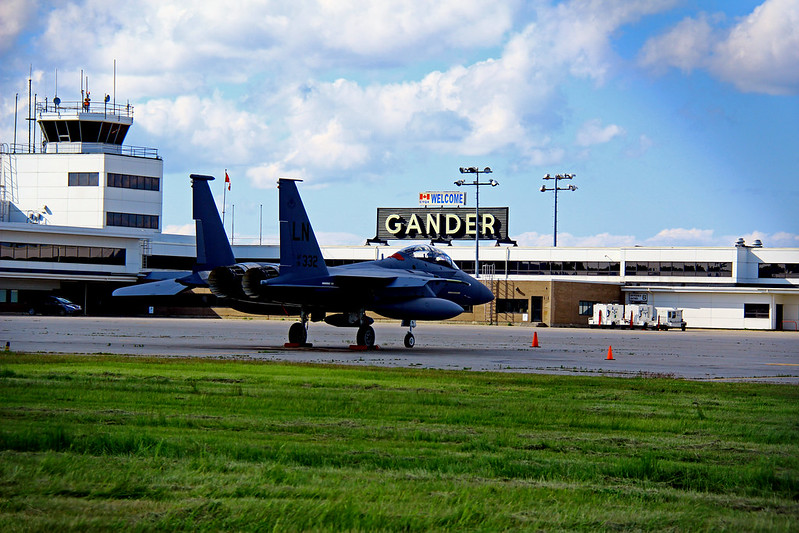
USAF F-15E Strike Eagles hanging out in Gander, Newfoundland?

Gander Airport - F-15
Credit: "No Name D" / Flickr - July 13th, 2015

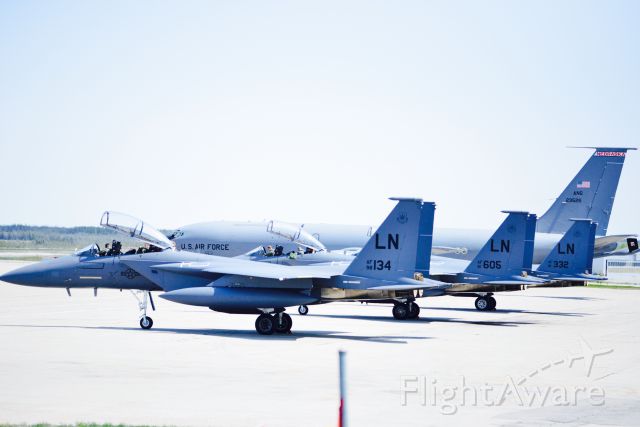
I'm not sure what the story is here, so I'm putting it out on the Internet to see if someone can fill in the blanks.  It seems on June 4th 2015 three USAF McDonnell Douglas F-15E Strike Eagles from RAF Lakenheath landed at Gander International Airport (CYQX) with a Boeing KC-135 Stratotanker.

Why is this interesting?

Several reasons.

At the time there was a rumour of an in-flight emergency, but I can't find any details.
There is also a rumour they were on their way to Iraq and/or the Azores (on their way to Iraq I guess?), but they're still there, as of last week.

The tail numbers of the planes are 98-0134, 91-0605 and 91-0332.
FlightAware Photo
Photo Courtesy of FlightAware.com - Rick Stead

Each of these planes are usually at RAF Lakenheath in the UK, as shown by the LN on their tail. (ref http://www.au.af.mil/au/awc/awcgate/af/tail_markings.pdf )

However, the tail also usually has a red or blue stripe along the top indicating their squadron, and the squadron number was painted on the tail as early as last year (ref: http://www.f-15e.info/joomla/operators/134-tailcodes#0-7-ln ) What does the lack of squadron number mean?  Are these being decommissioned, or redistributed to another base?
Either way, why keep the LN while in transit..?

Could this be related to the USAF re-org from the beginning of January 2015? (ref: http://theaviationist.com/2015/01/09/uk-base-selected-to-host-first-u-s-f-35-jets-in-europe/ )

More pictures here:
http://flightaware.com/photos/airport/CYQX/sort/date
http://jetphotos.net/showphotos.php?location=Gander%20Int%27l%20Airport%20-%20CYQX

...and HD video!


...and big thank you to Marcus and Todd for sending me photos when they were in Gander recently :)

June 21, 2015

SAC Reflex Action (1957-1965) Weapons Storage Areas

On October 1st 1957 the Strategic Air Command commenced an overseas alert operation, called Reflex Action, with twenty B-47 nuclear-capable bombers deployed to Sidi Slimane Air Base in Morocco.   This number would greatly expand over the course of the operation and include many more bases. Reflex operations would rotate bomber and refueling aircraft and crews to overseas bases where they would be disbursed away from CONUS, and be within striking distance of their targets.  The Reflex mission ended on March 31st 1965. (ref. Alert Operations and the Strategic Air Command, 1957-1991 - Diane Publishing Co.)

It shouldn't be surprising that the Army Corps of Engineers had designed and built Weapons Storage Areas along with the massive runways and hangers at all of the SAC air bases in the 1950s.  By all indications these WSAs were designed to handle and store open-pit detonators and nuclear bombs, to equip B-47s with a strike payload while on 90 day Reflex operations, on rotation from their home base.

Spain

Here we have the SAC Weapons Storage Area at the former Torrejon Air Base in Spain (40.4846, -3.4175)


Here we have the SAC Weapons Storage Area at the former Zaragoza Air Base in Spain (41.6482, -1.0316)


Here we have the former SAC Moron Air Base in Spain, also where B-47 Medium Bombers were deployed on Reflex missions.  Does the Weapons Storage area look at all familiar in design and layout yet?  (37.1742, -5.5947)


Morocco 

The former Ben Guerir Air Base Weapons Storage Area seems to have been expanded upon since the SAC moved out my the Moroccan Air Force, but the bones of the original (32.0988, -7.8969)


Sidi Slimane Air Base Weapons Storage Area (34.2151, -6.0419)


Nouasseur Air Base Weapons Storage Area (33.3659, -7.5530)

Canada

Goose Air Base (now CFB Goose Bay) - What do the above six US Army Corps of Engineers-designed and built USAF SAC bomber facilities have with Goose Air Base?  Goose had both Canadian forces and Canadian built buildings (at the NE side) and American facilities built on the South side.  Look at the area around where the push-pin is, and tell me what you see.  Isn't it remarkably similar in design to the nuclear Weapons Storage Areas at the above six bases?  The ring road? The earth covered magazines?  The little rectangular buildings?  Goose Air Base, now CFB Goose Bay, had the facilities to store nuclear bombs, and a squadron of B-47 Medium Bombers on loan from their bombing wing in the US, on rotation, every 90 days.  Why would you position B-47 nuclear-capable bombers, in the exact same type of facility that was built overseas (six times+) and not store nuclear bombs with them?  Clearly Goose Air Base was a forward operating location for retaliatory or first-strike against the USSR which had nuclear bombs on site. (53.2958, -60.3770)


CFB Cold Lake poses an interesting problem because it is still operation, has conventional munitions on site, and has been developed and built up by the RCAF.  It was certainly a refuelling base for KC-97 mid-air refuelling planes for Reflex, and there was (is) a Molehole at the South end of the air base where SAC KC-97 crews would be stationed on alert ready to fly.  But, did the base house any nuclear bombs during that time?  There exists an undeground facility at CFB Cold Lake to store equipment and potentially planes, but I have no evidence to suggest any of the weapons storage sites that are visible today, or underground, would have been built or used for nuclear bombs.  None of the usual buildings or layout indicating a presence of nuclear munitions are present at CFB Cold Lake (54.4021, -110.2794)

Denmark

Here we have the former SAC Sondrestrom Air Base in Greenland that was supposed to be a KC-97 refuelling base, and not a repository for nuclear weapons.  As far as I can see that's correct; there are no signs of nuclear weapons storage buildings or infrastructure to support those nuclear weapons.  Given the harsh environment, I suspect no nuclear weapons were stored at Sondrestrom Air Base. (67.0108, -50.7089)


Bermuda

Kindley Air Force Base in Bermuda was an SAC refuelling facility; other than four earth covered magazines that are overgrown with vegetation, I don't see anything that could resemble a (nuclear) Weapons Storage Area.  It looks like it was only a refuelling facility too. (32.3644, -64.6808)


England

RAF Fairford, England was host to SAC bombers as part of Reflex, and the Weapons Storage Area is slightly different, but the plant building and igloos are clearly visible (51.6792, -1.7649)


RAF Greenham Common, England, being of British design, not American, does not have the same WSA configuration as the American-built SAC sites, but clearly has hardened double fenced storage that would have been available for nuclear weapons storage.  B-47s were rotated in to the base, so it all ties together. Similar to the Canadian CFB Cold Lake, it was developed after Reflex, so it's hard to see what it would have looked like from present satellite photos (51.3774, -1.3024)


RAF Brize Norton, England was host to American SAC activity for Reflex Action, but I'm not 100% sure this munitions facility was used for nuclear bombs because of the differences in building design. (51.7408, -1.5657)


RAF Upper Heyford, England was also host to USAF SAC bombers, and has at least two Weapons STorage Areas (the other is NW of the point below, on the other side of the old runway. (51.9353, -1.2332)


So what, you ask?  Those are just the locations I pulled up out of one report (below), many more USAF air bases worldwide had Weapons Storage Facilities.  I was focusing on those which are documented as participating with the Reflex Action, since it fell smack in the middle of my are of interest with Goose Bay Air Base (1950-1971).  I'm not a PhD of architectural history, but with some common sense, I think you can see from the visuals above, you have a good sample of what air bases constructed by the Royal Canadian Air Force (CFB Cold Lake), the Royal Air Force (Brit), and the US Army Corps of Engineers look like.  My point is, they are all very different in design, and you can see from their design, what their mission was.  Large aprons or hard stands with nearby fuel farms (such as Sondrestrom AB in Greenland or Goose AB) show where refuelling planes would wait on alert.  Earth covered magazines in different configurations were arranged for safety from explosions that might happen at fuel dumps and were always located away from airplanes or other buildings in case of an explosion.  American-designed SAC Weapons Storage Areas for nuclear bombs were constructed as you see them above.  B-47 bombers were on alert at those same bases for the express purpose of dropping nuclear bombs on targets in the Soviet Union; either with a pre-emptive strike, or retaliatory strike.  The history of US Nuclear Weapons in Canada is incomplete, but I hope additional information will become declassified and reveal what the true history is of Canada's involvement with the Cold War.


Reflex seemed appropriate, no?

November 17, 2014

United States Strategic Air Command Facilities in Canada


I'm always surprised to find new types of installations or buildings that I didn't know existed.  I know that I know a very small corner of a much bigger pie of Cold War knowledge, but I had no idea I'd missed an entire class of hardened structures from the 1950s!

Moleholes
The "Molehole" (aka Mole-hole, or Mole Hole) is a hardened Alert building that would house, feed, and entertain American air crews flying B-47 Straojets, Air-refueling tankers like the KC-97, or other long range aviation assets' air crews, while they were waiting for the order to strike the Soviet Union.  They came in three sizes globally, depending on where and what kind of deployment of aircraft they would support; 18,000 square feet (70 men); 22,500 square feet (100 men); and, 31,000 square feet (150 men) - different versions of the molehole were built at SAC bases worldwide.  The six moleholes in Canada were all of the 18000sq ft / 70 man variety and were completely built by late 1959 or 1960.

"...alert areas went in at 65 SAC installations nationwide during 1956 to 1960, with a partially below ground, reinforced concrete alert quarters for the pilots built at each apron. The alert quarters, called moleholes, were in effect partially hardened, and not surprisingly were designed by the same Omaha architectural-engineering firm responsible for SAC’s underground command center of this same period, Leo A. Daly. With dispersal, SAC made some of its alert aprons bomber-only and some tanker. By the early 1960s bombers and tankers were sometimes on alert at a single installation—with tanker pens in addition to the Christmas tree configuration, and with house trailers again brought to the tarmac."
- "Cold War Infrastructure for Strategic Air Command: The Bomber Mission"
Prepared for; Headquarters, Air Combat Command, Langley AFB, Virginia

Hangers
For a hanger to fit an entire heavy bomber, medium bomber, or air refueling tanker, it needs to be quite large.  A more resource efficient way would be building a hanger that just barely fit the plane to keep the mechanics and hardware out of the elements, and could close the door around the ass end that was sticking outside - that was exactly what the United States Strategic Air Command did in the 1950s.  Those distinct looking hangers are still at several previously SAC airstrips across the world.

The US Strategic Air Command had six such bases where SAC assets were located in Canada.

    Namao (Edmonton / Lancaster Park AB)
    Cold Lake (AB)
    Churchill (MB)
    Frobisher (Iqaluit)
    Goose Bay (NL)
    Ernest Harmon AFB (Stephenville, NL) 


Namao, Alberta (3955th Air Base Squadron)
(...now CFB Edmonton -Lancaster Park)

Built as a refuelling base by the SAC, crews would be stationed for 2-3 month rotations from their home base in the United States.

RCAF Station Namao became Canadian Forces Base Edmonton (Lancaster Park) after unification in 1968.

At least one "nose hanger" is still in existence on the base, conveniently right near the molehole.

Molehole Location: 53.6595, -113.4467
The molehole looks to still be in use, but I do not know by which part of the Canadian Forces.  It is listed by the Department of Treasury as being federal building # 124206, in fair condition, with 2,147 sq. m. (23110.12 sq ft) of floor space - which doesn't jive with previous information!

Photo and Caption Credit to Harold McNeill
"c1961 A KC-97 Tanker refuels one of the USAF SAC bombers high over the Canadian Arctic.
This scene would have been repeated many times a day over nearly a decade.
The bombers, loaded with nuclear weapons,
were prepared to strike deep within Russia at the first sign
of an attack against the United States."


View Larger Map

View Larger Map

Seriously? There's a trailer park beside this one?  GO ARMY! 


Cold Lake, Alberta (3950th Air Base Squadron)

Molehole Location: 54.3948, -110.2638
Built as a refuelling base by the SAC, crews would be stationed for 2-3 month rotations from their home base in the United States.

Still in use by the Canadian Forces today, I believe called Building 104, was expanded with an addition.  The Molehole at CFB Cold Lake gets usedfrequently as the Air Force Tactical Training Centre (AFTTC)

Building 104 @ CFB Cold Lake
https://www.flickr.com/photos/59434634@N05/7973074760


View Larger Map


Churchill, Manitoba (3949th Air Base Squadron)

Molehole: End of Runway 33 - Destroyed

Courtesy Ivan Abolit


Original SAC hangers are still in existence on the former base.


Frobisher Air Base, Nunavut

Molehole: Unknown - Presumed Destroyed
SAC refuelling and/or Reconnaissance Base
Home of the USAF Strategic Air Command refuelling operation at Frobisher, an SAC base closed in 1963, when its refuelling operations were mostly taken up by tankers flying out of Goose Bay.

Original Nose Hanger:


Goose Bay, Labrador

(aka Building 248 per DND 5 Wing Goose Bay Area Site Plan, 1998)
"Goose Bay Alert Facility or Mole Hole taken in early 1962 by Hank Brown."

Note the Luria Engineering multi-purpose wing hangars on the right
two of which have been demolished, two remain
"301st AREFS KC-97Gs lined up at Goose Bay in 1962 on alert. The closest aircraft is 52-0850. The second aircraft is 52-0872, another 301st ARS aircraft. The one after that is 52-0857. The 301st AREFS had a very dark green diagonal stripe on the tail during the time."

CFB Goose Bay - 2001
 
CFB Goose Bay - 2001
 
CFB Goose Bay - 2001


Molehole: 53.3086, -60.4017
Reportedly, the molehole was still in use in 2002; I don't have any more recent information than that.  
According the the Treasury Board Secretariat the building is "occupied" (as opposed to vacant.  It is building number 125892 in their registry, which shows it was built in 1959 (which matches my other information), and measures 2716 sq. m. (29234.8 sq ft) which does *not* jive with the information I had.
At least two nose-hangers are in existence, and I have marked the map below with the other two (which are shown in the picture above!). 


View Larger Map


"Remains of former USAF storage bunker - 1 October 1983."
Credit: Barry Yager

"Remains of former USAF secure area - 1 October 1983"
Credit: Barry Yager


Ernest Harmon AFB, Newfoundland (4081st Strategic Wing)

Molehill: 48.5534, -58.5399
From what I read online, this molehole is now an accountant's office, and self-storage facility.
 

View Larger Map

Photo Credit: Shannon K. Green
via: http://planecrashgirl.blogspot.ca/2013/08/the-worst-disaster-in-history-of.html


At least four nose-hangers are clearly visible on the property of the former base. I believe the below is an example of a Luria Engineering multi-purpose wing hangar.

Photo Credit: Peter Mansell


The Big Picture


Sources:
    Terry L Horstead
    The City of Ottawa
    http://www.geocities.ws/kc97stratofreighter/301ars.html
    http://albertacanada.com/Cold_Lake_Hot_Shots_%28June_2010%29.pdf
    http://www.mcneillifestories.com/fire-walkers-chapter-1-a-nuclear-challenge/
    http://www.globalsecurity.org/wmd/facility/bomber_alert.htm
    US Nuclear Weapons in Canada, John Clearwater
    John Clearwater
    http://cryptocomb.org/Cold%20War%20Infrastructure%20for%20Strategic%20Air%20Command-The%20Bomber%20Mission.pdf

      August 23, 2014

      Air Bases Where Heavy Bombers Were/Are Based

      TU-95 Bear-H - April 23rd 2014
      Photo Credit: Unnamed RAF Typhoon pilot from RAF Leuchars
      http://theaviationist.com/2014/04/25/raf-releases-photo-bear/
      Nuclear-capable heavy bombers were based at the following air bases in the former Soviet Union and United States.  These locations were published by the US Government and relate to the START treaties, and I've just correlated with Wikipedia, Wikimapia, and put some push pins on the map.  You'll notice that the US bases are very much intact and active, and some of the former Soviet bases have become Russian bases, with the same planes, or the planes pulled back from Kazakhstan and Ukraine after the collapse of the USSR - also, very active. 


      Information about the matching Soviet (now Russian) air bases seems harder to pin down, at least all in one spot, but the START treaties and other sources define them as the following.  There is an impressive line-up of TU-95 long range bombers on the tarmac at Ukrainka and Engels-2, but we can't really tell how many of those planes are air-worthy.

      Engels Air Base (Энгельс-2)
      http://en.wikipedia.org/wiki/Engels-2

      Dyagilevo Air Base (Дягилево) (UUBD)


      Ukrainka Air Base (Украинка)
      http://en.wikipedia.org/wiki/Ukrainka_(air_base)


      Uzyn (now Ukraine)
      NA - (49°47'33"N, 30°26'14"E)


      Pryluky (now Ukraine)
      http://en.wikipedia.org/wiki/Pryluky_%28air_base%29


      Dolon Air Base (Погода) (Now Kazakhstan)
      http://en.wikipedia.org/wiki/Dolon_%28air_base%29


      Belaya Air Base / Irkutsk Belaya (Белая) (UIIB)

      Vozdvizhenka Air Base
       http://en.wikipedia.org/wiki/Vozdvizhenka_(air_base)

      Ozerne Air Base (Озерное) (UKKO)

      Ulan-Ude Airport (Mukhino) (Мухино)

      Nizhyn Air Base (now Ukraine)

      Shatalovo Air Base (Шаталово)

      Zavitinsk Air Base (Завитинск)

      The Soviet strategy would have been to launch the heavy bombers from those bases, and those which had to refuel would do so at "bounce" aerodromes in the Arctic along the way.  Looking at the current state of these airfields, you can draw your own conclusions regarding if they are in use or have been abandoned.  They sure look well maintained, or even developed, to me.  Granted, some of the aviation is civil, but a "bounce" is really only meant to refuel for the 2nd leg of a journey across the pole.

      Countering this threat of coming over the pole, NORAD set up 5 4 forward operating locations (FOLs) in Canada where NORAD interceptors could stage out of, and counter the Soviet threat.

      Here are those "Bounce Aerodromes"

      Sredniy Ostrov Aerodrome (Аэродром Средний Остров) (UODS)
      http://en.wikipedia.org/wiki/Sredny_Ostrov
      [No imagery available]

      Olenya Aerodrome (Аэродром Оленья)  (XLMO)
      http://en.wikipedia.org/wiki/Olenya_(air_base)


      Vorkuta Airport  (Аэропорт Воркута) (UUYW)
       http://en.wikipedia.org/wiki/Vorkuta_Airport


      Tiksi Airport (Аэропорт Тикси) (UEST) 
      http://en.wikipedia.org/wiki/Tiksi_Airport


      Ugolny Airport / Anadyr (Аэропорт Угольный) (UHMA)


      Mys Shmidta Airport (Аэропорт Мыс Шмидта) (UHMI)


      Rogachevo Aerodrome (Аэродром Рогачёво) (ULDR)

      Other air bases of note which were not releated specifically to heavy bombers:

      Lakhta air base
      https://en.wikipedia.org/wiki/Lakhta_air_base


      Kamenny Ruchey (Mongokhto, Alekseyevka, Mongohto) (Монгохто, Каменный Ручей) (UHKG)
      https://en.wikipedia.org/wiki/Kamenny_Ruchey

      Bolshoye Savino / Perm International Airport (USPP)
      https://en.wikipedia.org/wiki/Perm_International_Airport

      Ivanovo Severny (Ivanovo North / Zhukovka)
      https://en.wikipedia.org/wiki/Ivanovo_Severny


      Kansk
      https://en.wikipedia.org/wiki/Kansk_%28air_base%29

      Borisovsky Khotilovo (Borisovskiy / Borisovsky / Khatilovo)
      https://en.wikipedia.org/wiki/Borisovsky_Khotilovo

      Savatiya (Kotlas South, Savati, Savvatiya) (ULKS)
      https://en.wikipedia.org/wiki/Savatiya

      Morshansk (Tambovo)
      N/A

      Omsk-Severnyj Air Base (Omsk)
      54°58'25"N   73°33'16"E
      N/A

      Ostrov (Gorokhovka)
      https://en.wikipedia.org/wiki/Ostrov_%28air_base%29

      Petropavlovsk-Yelizovo (Yelizovo Airport / Аэропорт Елизово) (UHPP)

      https://en.wikipedia.org/wiki/Petropavlovsk-Kamchatsky_Airport

      Chuguyevka (Chuguevka, Sandagou, Sikharovka, Sakharovka, Sokolovka, Bulyga-Fadeyevo)
      https://en.wikipedia.org/wiki/Chuguyevka_%28air_base%29

      Savasleyka (Саваслейка)
      https://en.wikipedia.org/wiki/Savasleyka_%28air_base%29

      Shaykovka (Шайковка) (Kirov Shaykovka, Anisovo Gorod, Anisovo Gorodishche, Shaykovo, Shajkovka, Gorodische, Chaikovka)
      https://en.wikipedia.org/wiki/Shaykovka

      Soltsy-2 (Sol'tsy, Soltsy, Solcy, Solcy 2) (XLLL)
      https://en.wikipedia.org/wiki/Soltsy-2


      December 29, 2012

      1st Lt. Gaylord B Treu, USAF Fighter Pilot - Missing in Northern Ontario since 1959

      1st Lt. Gaylord Treu, USAF
      (date unknown)

      I thought I'd written a post about USAF Pilot 1st Lt. Gaylord Treu previously, but it seems I only mentioned him in passing. 

      1959
      Years, or eras, are characterized (in my mind anyway) around events.  Off the top of my head, 1959 isn't closely tied to anything I know of - so I had to look it up.  War-wise, I know it was after Korea, and arguably before Vietnam.  The Cuban revolution was in full swing.   Buddy Holly, Ritchie Valens, and The Big Bopper died in a plane crash.  The Avro Arrow was cancelled paving the way for the BOMARC.   Dwight Eisenhower was the US president and the USSR Premier was Nikita Khrushchev.  The St. Lawrence Seaway was opened.  Alaska and Hawaii became States.  The first Xerox photocopier was sold to the public.  MGM released Ben-Hur (it was a big deal at the time, winning 11 Academy Awards!)  Pantyhose were introduced. 

      I was born in the 1970s, and it's hard for me to imagine a world without the St Lawrence Seaway, pantyhose, or the photocopier...

      In 1959 The Cold War "war machine" was in high gear, the USAF fighter pilots were getting newly designed fighter jets every few years, and training was at an increased tempo.  The Pinetree Line of radar stations stretching across Canada from coast to coast to coast was fully operational; some of the facilities were being run by the RCAF, while others were manned by the USAF.  I think the reach of those radar stations was limited to a few hundred kilometers, and there was little in the way of "computers" as we know them now.

      While researching RCAF Station Pagwa I discovered it had previously been USAF Pagwa Air Station (Pagwa AS) as it had been built and run by the Americans originally.  Around the same time I also noticed that there had been a "Dull Sword" incident in 1959 near Pagwa, which caught my eye.  A "Dull Sword" is one of the least severe "Special Weapons" (aka Nuclear Weapons) incidents, not necessarily involving nuclear weapons at all, but it could be an incident which impairs a nuclear weapons delivery system (like, a B-47 nuclear-capable bomber).

      Looking for more information on that incident, I came across a 1st hand recount of the rescue operation to find the downed pilots, a result of a mid-air collision while flying exercises, on another blog.

      http://www.clarenceworly.com/2011/03/21/the-story-of-an-american-hero/

      That sparked my interest even more.  Of the pilots and crew who crashed that day, everyone was recovered except for the pilot of the F-102, Lt. Gaylord Treu.  No news articles mentioned ever finding the downed USAF pilot, ever, since 1959.  Was he ever found?  Did it just miss the news?  Could be - that was a long time ago.  So, I Googled some more...  I found pictures of the missing pilot and his peers, I even I found a picture of his grave, and the announcement of the funeral in the local paper from that time - but nowhere did I find mention of his remains being returned to the United States.  Isn't that weird?

      In December of 1959 1st Lieutenant Gaylord B Treu took off from Kincheloe AFB, and hasn't been back on American soil since.  This rubbed me the wrong way, and I was looking for a sign that he was listed, somewhere, as MIA.  I looked on the list of "Cold War" MIAs, but didn't find him.  I expanded my search to all US military men who were missing, still nothing.  It was from that, that I contacted the JPAC, and asked them.  Initially rebuffed, I persisted, and they looked into it.  I'm not entirely sure if Lt Treu was on "a list" somewhere at all, but they did find records to corroborate what I was telling them.  I asked why he wasn't on the Cold War "list", as he was clearly preparing for a war (that never came) when he died.  This is the part that surprised me; he didn't die during a combat operation, therefore he isn't considered a casualty of the "Cold War".  Wow, that is cold indeed.  Considering he wouldn't have been flying over Northern Ontario intercepting simulated Soviet bombers if there wasn't a Cold War going on, and he died while training for that war, I think it's a little insulting that he isn't listed as MIA "during" the Cold War.  Oh well, I'm sure I'm not the first one to question the wisdom of the federal bean counters.

      In order to get more information from the resources in the USAF and DOD I need to fill out a Freedom of Information Act request - and I don't know exactly how (as a foreign national) that will go.  I'll try in the new year.  At the same time I was trying to contact the JPAC, I was trying to reach out to Lt Treu's surviving relatives - and with the help of his extended family, astonishingly (to me) found his son (who was very young when he died), and most recently great niece!  That also means that if any remains are found that have any DNA, identification of the remains might be possible.

      I haven't yet seen the accident report for the incident, so I'm not sure how it was originally classified (Secret, Top Secret, etc..) but it was deemed to be a "Dull Sword"; I would *guess* that any nuclear-related incident would automatically get a higher than normal classification.  I don't know what the classification of a military crash accident report would be anyway.  My point is, perhaps because the incident was a "Dull Sword", maybe Lt Treu's status was filed away in a seperate list of MIA individuals.  Also, maybe I'm just seeing things and the right answer is the most obvious - maybe they don't have great records that date back to 1959?  I'd hope that's not the case.  Anyhow, I hope the dust has been blown off his file.

      I hope once I find a copy of the accident report I'll have a better idea of where the crash occured, what direction the debris fell, and over how much area was it spread.  The exact quote from John Clearwater's book is

      "LOCATION: 130 km north of Calstock, Ontario, or, 65 km northeast of Pagwa, Ontario 50.30N 84.18W"

      In case you look that up, 130Km North of Calstock doesn't really intersect with 65Km NE of Pagwa.  I've put the points on the map below to try and show the area in which it seems his F-102 and the B-47 crashed.  One of the problems is, of course, when they collided they were moving at considerable speed, at considerable height.  Wreckage was strewn far and wide.  Generally, I would think the wreckage would have fallen in a cone or triangle pattern from the point of impact.  Unfortunately, I don't know where they impacted, what direction they were going, their height, speed, or anything.


      View Location of Lt Treu's F-102A? in a larger map

      If you use the closest three pushpins and searched between them (which there is no info proving the plane's wreckage is in the middle and not over the edge of any of those lines, you'd be searching 77,000 acres, or 312.5 Sq.Km.  It's a lot more space than it looks on the map.

      Gaylord Treu's Squadron at Kincheloe AFB posing in front of an F-102 Delta Dagger
      Back row: Capt. Joe Minnex, 1/LT John Conoway.
      Front row: 1/Lt. Gaylord Treu, Capt. Rusty Klein, Capt. Dick Erickson.

      I know that new ground penetrating imaging is being used (successfully) to find Unexploded Ordinance (UXO), so I wonder if new technology that was certainly not available in 1959 could find any more of Lt. Treu and his aircraft.  The size of the piece of land I've illustrated above is huge, and truly a needle in a haystack.  My hope is to narrow down where the crash happened.  His helmet was never found, and parts of the plane were never found.  My hope, best case scenario, is that his remains might someday be found, and returned to his native land.


      Kincheloe AFB, Michigan. F-102 Deuce, Delta Dagger.

      F-102 Cockpit

      F-102 Ejection Seat

      B-47E Stratojet - Tail # 51-7082 
      This is an earlier picture of the B-47E Lt Treu's F-102A cut in half.


      November 03, 2012

      Visit to the North Bay BOMARC Site

      On our way back from our trip (October 22nd, 2012), with only two of four brakes working (which is another story) we stopped behind the BOMARC site at North Bay.  Whenever I've passed by previously the gate has been closed, as I've been travelling at odd hours or on the weekend.  I was surprised to see the gate open as we left, but we were out of time, and had already been taking pictures from the rear of the base.

      Tip:
      To take pictures from the rear of the base, we parked on the ATV trails along the natural gas line which runs North/South to the West of the base.  Take BOMARC Road off HWY 11, past the trailer park, and take a left on the pipeline access road/ATV trail.  I would not recommend this in something other than a high 4WD vehicle, the road is not maintained to a quality suitable for car traffic.

      Lesson Learned:
      • Plan time for stop at North Bay BOMARC during business hours

      I was quite impressed that the self-storage facility which now owns the property is keeping the place together pretty well.  I'm glad to see most of the buildings still there.  I wish they could get a grant to paint the buildings to their original colours, but it is a private business, so I doubt that will happen.  Surely it's a site of historical significance that is worthy of getting some of my tax dollars.

      USAF BOMARC Missile Maintenance Bays

      BOMARC Launchers

      BOMARC Launchers


      BOMARC Missile standing at the ready
      Courtesy pinetreeline.org

      North Bay BOMARC Site
      Courtesy pinetreeline.org


      View Larger Map